Why you are always tired
The Energy Deficit No One Talks About in IBD

Most people on their natural healing journey start zeroing in on repairing the gut/looking at diet. And while this is an element of healing there is a deeper story at play.
Because when you live with inflammatory bowel disease, your energy isn’t just low - it’s depleted at the cellular level.
All subscribers receive My Flare-Happy Foods guide - which gives you simple, soothing meal ideas and food swaps to help calm your gut and feel safer eating during Crohn’s and colitis flares.
I remember one of the biggest roadblocks initially was that I was so bloody tired! How could I even be bothered trying to support my body and learn how to nourish it when I struggled to get out of bed in the morning.
But when I started understanding what was going on with my body at a cellular level and took action appropriately, things started to get better. Let me break it down further:
When you live with inflammatory bowel disease, your energy isn’t just low - it’s depleted at the mitochondrial level.
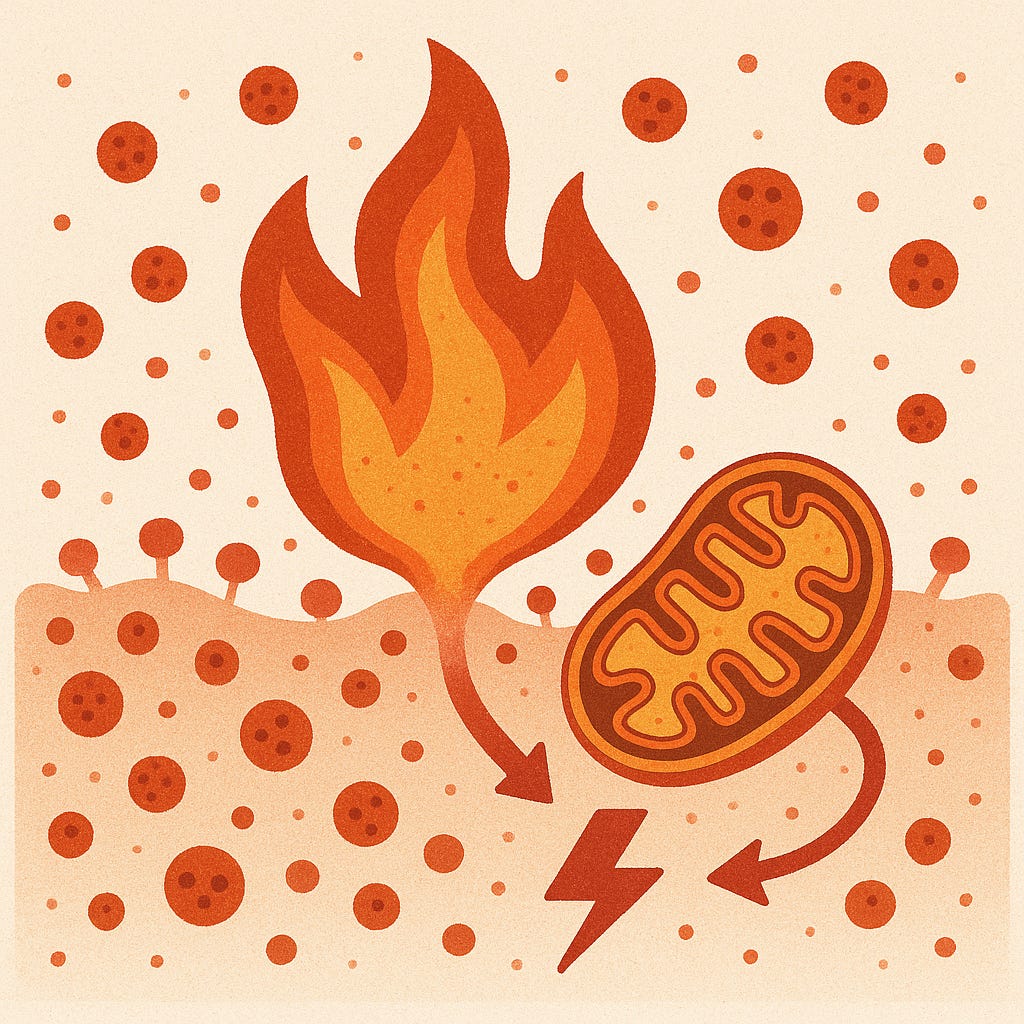
Inflammation is an energy-hungry process. Every flare, every immune activation, every “fight” your body mounts against food or microbes demands enormous ATP (energy).
The mitochondria - your cell’s power plants - are already under strain from oxidative stress, nutrient malabsorption, and gut-driven toxins. When these power plants go offline, your body enters a chronic energy deficit.
That’s why you can feel tired after even gentle movement, struggle to recover from workouts, or crash for days after pushing yourself. I remember struggling to get through a school day without zoning out or feeling like I needed to have a nap. These were early warning signs of this depletion (even though I didn’t know it at the time).
Also - another important point to note: Exercise can heal or harm, depending on your mitochondria.
When your mitochondria are compromised, exercise becomes another stressor - another “energy withdrawal” your body can’t repay.
You’re already using huge amounts of energy to manage inflammation, detoxify endotoxins, and repair the gut lining. Add intense exercise on top, and your body simply runs out of cellular fuel.
That’s why so many people with IBD feel worse when they “push through.”
Their body isn’t lazy. It’s protecting them.
True recovery from IBD isn’t just calming inflammation, it’s about rebuilding mitochondrial capacity.
That means:
Nourishing with the right fats, minerals, and antioxidants
Supporting gentle detox so mitochondria can breathe again.
Focusing on rest, oxygenation, and circadian alignment before high-output training.
Once your mitochondria start making energy efficiently again, the fatigue lifts and exercise becomes a deposit, not a debt.
Think of your energy like money in a bank account.
If you’re inflamed, you’re already in overdraft.
Every stressor, physical, emotional, environmental, is a withdrawal.
Healing, rest, and nourishment are deposits.
The goal isn’t to stop moving. It’s to spend wisely while rebuilding your reserves.
That might mean trading HIIT workouts for walks, mobility work, and sunlight exposure until your body tells you it’s ready for more.
IBD isn’t just a gut disorder, it’s a cellular energy disorder.
And when you start supporting your mitochondria, the entire system begins to recalibrate.
When a flare hits, the last thing you need is another night of desperate Googling.
You want to know what to reach for, what to pause, and how to give your gut a chance to settle without guessing.
Calm the Flare is a practical, PDF guide that walks you through a simple 3-step framework I use myself to ride out Crohn’s/IBD flares with more stability: Check it out HERE